|
||||||



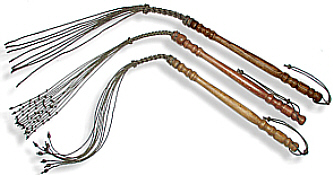
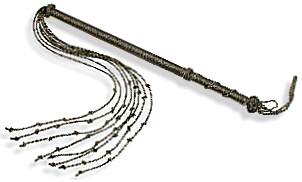
The Heavy Codline CatsPrison Cats, Thieves’ Cats, the Newgate Cat and the Jailer's CatHaving done a lot of research into the subject of historical physical punishment, we have created these functionally authentic reproductions of the 19th Century British prison system's now-outlawed instruments of corporal discipline. Our versions are more finely made than the original and have been engineered for easier use and longer life -- but are no less savage, for all of that. The
material we use is “tarred codline.” This is a twisted nylon twine,
saturated with something like “road tar” in order to make the fiber
denser (it sinks in salt water) and to protect it from abrasion. It
is used primarily for commercial fishing nets We
do several styles: one with knotted tress ends -- the Thieves'
Cat -- using a 1/8” in diameter cord for the 8-tress model and
roughly 1/16" for the 12-tress version; heavier in diameter,
.15" in diameter, is the one with whipped ends -- the
Prison Cat. We
later added the Jailer's Cat. The first was made on request
for a good customer who did not have the space nor the hand power
to wield one of the larger ones. In 18th and 19th Century armies and prisons, whip tresses were most often 1/8” diameter woven “whipcord” -- left unknotted and unwhipped. When knotted, to increase severity, only one or two knots in the end of each lash were used. Whipped ends make narrow welts and sometimes make clean cuts which draw blood. Knotted ends tend to crush rather than cut. They make blue bruises and tend to tear, rather than split the skin. We put five knots about an inch apart at the end our Thieves’ Cat lashes. This practice is taken from the designs used for “Religious Disciplines,” which seems to reduce the amount of damage just a bit. (The original standard appears to have been more than two feet of tresses on a two-foot handle which, in practice, is just a bit too long for modern ceiling heights. Besides, it generates a lot of power for unincarcerated people with whom one might wish to play again.)
We now include a version of the Thieves' Cat
that had been made on special order. If "bigger is better"
this one is the best of the lot! The proportions are indeed the ones
we cited as "original standards."
(We
can also quote on the requirements of “Reenactors” and others
who demand absolute visual, material and historical accuracy.)
| ||||||
| Jailer's | 33" long 6 tresses, whipped |
Reg
$110.
$95. |
 |
K076 | ||
| Newgate | 39” long 8 tresses w/1 knot ea |
$110.
|
|
K075 | ||
| Prison | 39” long 8 tresses, whipped |
$125.
|
|
K071 | ||
| Thieves' | 39” long 8 tresses, knotted |
$145.
|
|
K072 | ||
| Prison | 45” long 12 tresses, whipped |
$165.
|
|
K073 | ||
| Thieves' | 45” long 12 tresses, knotted |
$195.
|
|
K074 | ||
| Big Thieves' | 50” long 8 tresses, knotted |
$185.
|
|
K077 | ||
|
Vegan
|
 |
Cats
|
|
Cats
II
|
|
|