|
Tress
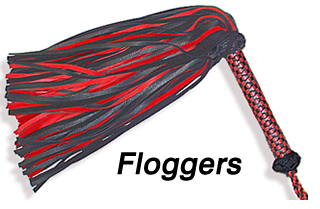
is such an apt description of the thick, flowing bundle of strips
at the business end of the modern pleasure flogger. It is a fairly
modern term; I learned it from the New York whipmaker, Luchia,
at the club Paddles in 1987 or 88. If one wants to be pedantic,
there are traditional terms: cats have 4 - 10 tails,
while whips have a single lash or thong but in
everyday usage, the term tress covers the business end
of both cats and floggers.
A flogger gets most of its effect from the final few inches of the
tress. Everything else in the design exists to deliver those tress
tips to their target accurately and at the desired force and speed.
Cascade
A well-designed general purpose flogger
should be able to make the tips either hit together in a tight bundle
even at slower speeds, or can be made to spread out and fall in
a gentle cascade of tress tips. In judging the tress
itself you want to see uniform width and cleanly cut material. On
a new flogger you want to see uniform tips, and tresses all the
same length give or take a leather-thickness or two. As a
whip is used, the tresses may stretch, (this is true especially
of deer and moose hide) or they may fray (particularly with very
narrow tresses or with suede). The answer is an occasional trim
with a sharp scissors.
Very little cowhide made in the last five
years is struck i.e., dyed all the way through.
As that trend emerged, some of the more particular premium whipcrafters
began to dye the cut edges of their leather. As a result, colored
tress edges came to be associated with the highest standards of
workmanship. Attractive as this embellishment can be, it doesnt
actually add anything to the quality of the flogger, but it does
add to the cost and can be used to make a second- or third-
rate product resemble the top of the line.
Design
Assuming the arm (the speed and power
of the stroke) is constant, the performance of the flogger and its
actual effect ... what it feels like, whether or not it will make
bruises or break skin, for example is determined by the tress
design. This includes the length, width, thickness, shape, texture,
and hardness of the individual tresses, as well as the length and
mass of the total tress bundle.
Here
the raw number of tresses in a flogger is only half the story. Garment
weight cowhide, for example, ranges from 1/32 to as
much as 1/8 in thickness. In thicker leathers, strips taken
from different places on the same hide can vary in thickness by
as much 50%. The thickness of the individual tresses needs to be
considered, or else the diameter of the bundle as a whole must be
specified.
Adam then goes on to discuss the following
topics:
Braiding
Braided tress is a luxury, but it is more than an affectation.
...
Variables
-- In
choosing or designing a flogger these variables need to be considered:
Denser tresses move faster and hit harder than airy
ones.
Soft, flexible
tresses are more sensual and less likely to do less skin damage
than hard, stiff ones.
Thin, hard,
narrow or round tresses in sparse tress bundles (typical of cats)
are usually intense and severe.
Wider tresses
have more wind resistance than narrower ones and therefore move
slower.
The narrower
tress has more sting the wider, more slap.
Tress
Bundle Thickness
Materials
---
Full
Grain Cowhide, Cow Suede, The Game Hides, deer, moose,
elk, Rubber, Cordage, Pigskin and Pig Suede, Horsehair ...
There
are few substances that have not found their way to the front end
of someones flogger. This includes all kinds of plastic tubes
and sheet, fish and reptile skins, insulated and bare wires, and
even light chain. However, the ones discussed in this article are
the most common and most safe and sane. ...
As with cameras, swords and handguns,
in the last analysis, the right balance is the balance
that feels right to the user! Whipcrafters work towards an optimum
feel relying on experience and experiment rather than
formula. Changing the weighting without also adjusting handle and
tress dimensions rarely improves an established design. If your
personal preferences are very specific, you will need to find a
Whipcrafter whose standard designs suit your tastes, or consult
with a Whipcrafter who does custom work. Often a very small price
premium will get you exactly what you want. However, when a Whipcrafter
must copy anothers work exactly, that Flea market
special you paid fifteen dollars for ten years ago, may cost hundreds
of dollars to recreate! © aswgt.inc.
2008
Adam
Selene (aka Mitch Kessler) has been a whipcrafter since 1987,
when friends started asking him to make one for me,
of the designs he had crafted for his own use.
|